
New Agathon University Press commentary, available soon from booksellers everywhere, offers a fresh examination of one of Scripture’s most frequently misunderstood books through careful Hebrew exegesis and plain interpretation.
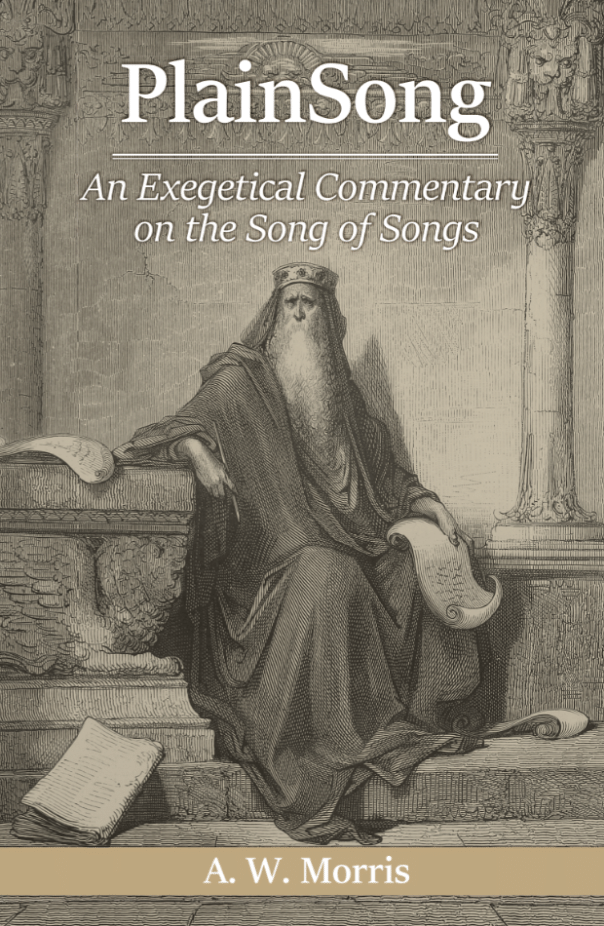
Agathon University Press is pleased to announce the publication of PlainSong: An Exegetical Commentary on the Song of Songs, a new work by Dr. A. W. Morris that offers a rigorous, text-centered examination of one of the Bible’s most beautiful, intriguing, and frequently debated books.
Throughout centuries of Jewish and Christian interpretation, the Song of Songs has generated remarkably diverse explanations. Some have understood its poetic descriptions of romantic love as allegories of God’s relationship with Israel or Christ’s relationship with the Church. Others have approached the Song as a celebration of human romance, while still others have sought deeper spiritual meanings beneath its intimate language.
In PlainSong, Morris asks a foundational question: What if the Song of Songs means precisely what its inspired author intended to communicate through the ordinary language, literary forms, and historical context of the text?
The result is a substantial exegetical commentary that challenges readers to reconsider traditional assumptions and rediscover the theological significance of God’s design for marriage, intimacy, and human relationships.
Recovering the Plain Meaning of Scripture
At the heart of PlainSong is a commitment to grammatical, historical, and contextual interpretation. Rather than imposing theological symbolism upon the Song, Morris carefully examines the Hebrew text to identify the meaning communicated by its author.
His approach does not disregard the Song’s rich poetic imagery. Instead, Morris demonstrates that figures of speech, metaphors, and literary devices must be understood according to their normal communicative functions.
This distinction is particularly important for a biblical book filled with vivid descriptions of beauty, longing, affection, and physical intimacy.
Morris argues that the Song should not be transformed into an allegory simply because its subject matter appears insufficiently theological to some interpreters. Rather, its theological significance emerges naturally from its portrayal of God’s good creation.
The Song’s celebration of marital love, he contends, is firmly grounded in the creation account of Genesis 1–2. The poetry provides an extended portrait of the emotional and physical dimensions of the marriage relationship that God established from the beginning.
A Distinctive Contribution to Biblical Scholarship
One of the commentary’s most significant contributions is its careful examination of the relationship between the Song of Songs and the life of Solomon.
Morris defends Solomonic authorship while challenging the assumption that Solomon himself, or one of his many wives, must be a principal character in the poem.
Through detailed engagement with the biblical historical narratives, he examines the tension between Solomon’s polygamous life and the Song’s celebration of exclusive marital devotion.
Morris proposes that the Song’s husband and wife are best understood as literary characters whose relationship portrays God’s intention for marriage rather than describing a particular historical romance.
This interpretation allows the Song’s message to extend beyond the experience of any one couple and speak meaningfully to the institution of marriage itself.
The commentary also engages competing interpretations, evaluates relevant scholarly arguments, and examines the linguistic and historical evidence concerning the Song’s authorship, date, and structure.
More Than a Verse-by-Verse Commentary
Although detailed Hebrew exegesis forms the foundation of PlainSong, the volume extends beyond the interpretation of individual passages.
Following its extensive introduction and exposition of the biblical text, Morris explores the relationship between the Song of Songs and New Testament teaching. These discussions address monogamy, the inherent goodness of marriage, mutuality in marital intimacy, the earthly nature of marriage, and the wedding feast of the Lamb.
An additional chapter considers the challenges and responsibilities of preaching the Song of Songs, helping readers bridge the distance between careful interpretation and faithful biblical exposition.
The volume concludes with an extended excursus on Genesis 3:16, examining the Hebrew terminology and competing interpretations of a passage that has significantly influenced discussions of marriage and the relationship between men and women.
Together, these features make PlainSong a valuable resource for pastors, professors, seminarians, Bible teachers, and serious students of Scripture who desire to engage the biblical text with greater precision and consistency.
A Commitment to Faithful Biblical Interpretation
The publication of PlainSong reflects Agathon University Press’s commitment to producing substantive scholarly resources that encourage careful biblical interpretation, theological understanding, and thoughtful engagement with Scripture.
Morris’s work demonstrates that rigorous exegesis need not diminish the beauty or practical significance of the biblical text. On the contrary, allowing Scripture to communicate according to its own literary and historical context can reveal dimensions of its message that are easily obscured by interpretive traditions.
In the case of the Song of Songs, that message includes the goodness of God’s creation, the beauty of marital devotion, and the profound significance of the relationship between husband and wife.
For readers accustomed to approaching the Song primarily as an allegory, PlainSong offers a compelling invitation to reconsider its meaning. For those already committed to grammatical-historical interpretation, it provides a detailed and challenging demonstration of that method applied to one of Scripture’s most distinctive literary compositions.
Agathon University Press invites readers to discover PlainSong: An Exegetical Commentary on the Song of Songs and explore how careful attention to the biblical text illuminates God’s design for marriage and human intimacy.
Book Details
PlainSong: An Exegetical Commentary on the Song of Songs
Author: Dr. A. W. Morris
Publisher: Agathon University Press
Publication Year: 2026
ISBN: 978-1-60265-108-1
For more information about Agathon University Press and its publications, visit https://www.agathonu.com/press/.